What Makes Up Australian Employment Law?
Who is this for?
This article is for anyone who wants a clearer understanding of how Australian employment law fits together, particularly HR professionals, managers, employers and people who work with workplace issues but may not have a legal background.
A quick disclaimer
I am an HR professional, not an employment lawyer. I have a strong interest in Australian employment and workplace law and spend time reading legislation, Fair Work resources, decisions and other material to better understand how the system operates in practice. This article reflects that learning, together with my professional experience working in HR.
This article is intended as general information and reflects my own interpretation of the legislation, government resources and other material I have read. It is not legal advice and it is not intended to replace the Fair Work Act, modern awards, enterprise agreements, state or territory legislation, government guidance or any other official source.
Australian employment law can be complex, and the correct position will often depend on the particular employee, employer, industry, jurisdiction and circumstances involved. Laws, awards and government guidance can also change over time, so it is always important to check the current source material.
Where a workplace issue is significant, disputed or unclear, the relevant legislation and official government resources should be consulted and, where appropriate, advice should be obtained from a suitably qualified professional, such as an employment lawyer.
An overview: the Fair Work Act, Commonwealth and state laws, modern awards, enterprise agreements, employment contracts and common law
Australian workplace relations and employment law is made up of a number of different laws, legal instruments and sources of rights and obligations. While the Fair Work Act 2009 (Cth) sits at the centre of Australia’s national workplace relations system, it does not represent the entirety of Australian employment law.
I wanted to start by looking at this broader landscape because understanding where workplace rights and obligations come from is an important part of understanding how the system operates in practice. Depending on the issue, the answer may be found in Commonwealth legislation, state or territory legislation, a modern award, an enterprise agreement, an employment contract or principles developed through the common law. In many cases, more than one of these will apply at the same time.
The national workplace relations framework
The Fair Work Act 2009 (Cth) is the principal legislation governing Australia’s national workplace relations system. It establishes much of the framework we commonly associate with Australian workplace relations, including the National Employment Standards, the modern award system, minimum wage arrangements, enterprise bargaining, general protections and unfair dismissal.
However, the Fair Work Act operates within a much broader employment law landscape. Other Commonwealth legislation and state and territory laws regulate areas such as discrimination, work health and safety, workers’ compensation, long service leave, superannuation and paid parental leave. Employment contracts, modern awards, enterprise agreements and common law principles can also create or affect workplace rights and obligations.
This is important to understand because it explains why the Fair Work Act will not cover every single scenario in a workplace relationship and it also indicates that there are other Commonwealth, state and territory laws, as well as common law principles, to take into consideration. It also represents the complexity of the Australian workplace relations system. There are workplace entitlements or obligation that are available to employees and need to be followed that are not necessarily listed in the Act. Depending on the issue, we may need to look to other legislation or legal sources to determine what applies. The Fair Work Act and the state and territory employment laws also co-exist and overlap.
Long service leave is a good example of this, as the applicable entitlement may be found in state or territory legislation rather than being fully prescribed by the Fair Work Act. Portable long service leave provides an even clearer example. In certain industries, separate state and territory legislation establishes portable long service leave schemes that allow workers to accrue qualifying service across different employers within that industry. These schemes can create registration, reporting and levy obligations for employers even though those obligations are not contained in the Fair Work Act. This demonstrates why checking the Fair Work Act alone is not always enough to determine an employer’s workplace obligations. Understanding where a workplace right or obligation comes from is therefore just as important as understanding what that right or obligation is.
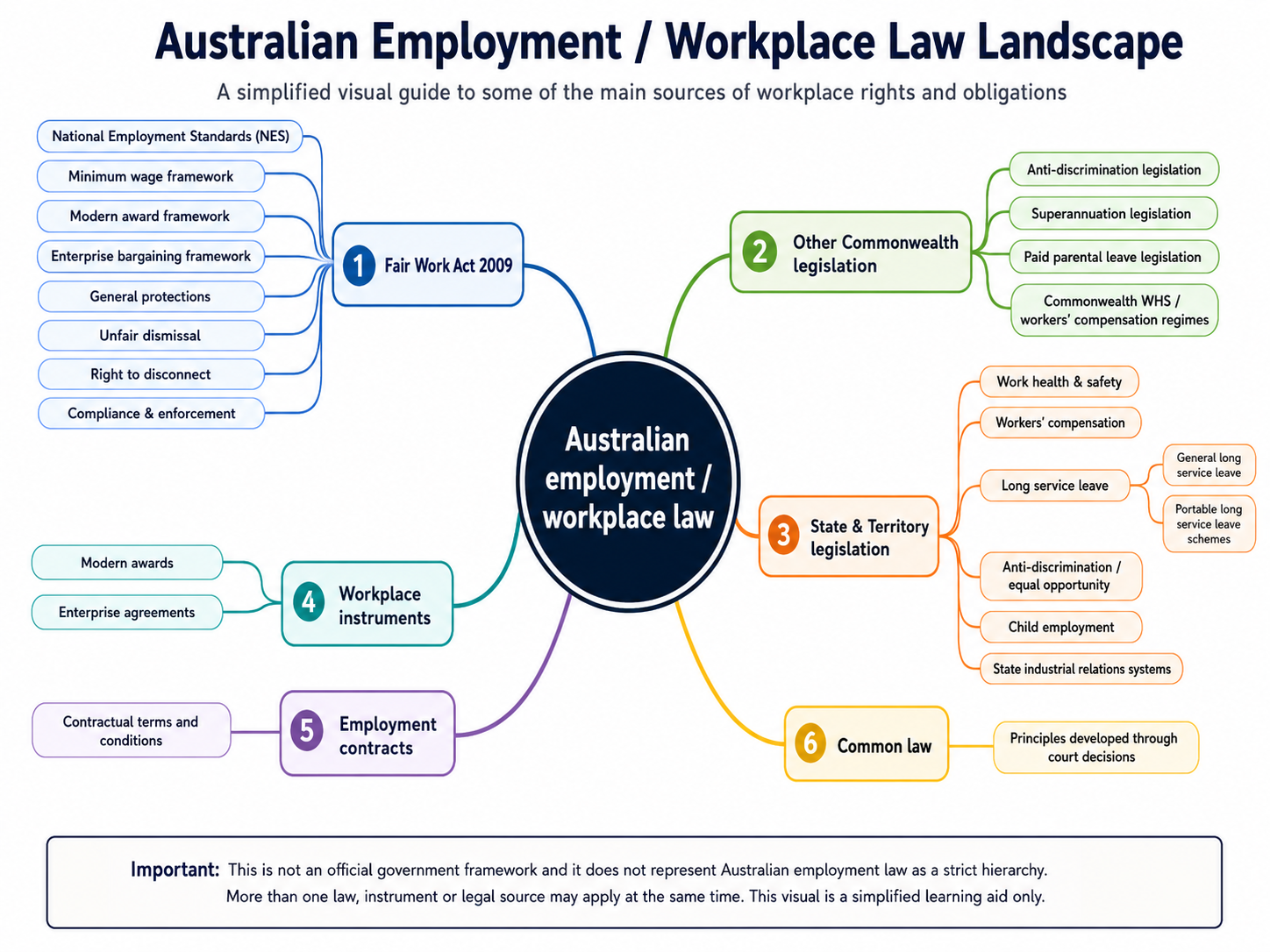
A mind map of the Australian Employment Law Landscape
I asked AI to help me come up with a diagram that would assist me in visually mapping out some of the main sources of workplace rights and obligations across the Australian employment law landscape.
A few important points about this diagram: it is not an official government framework and it does not illustrate how employment law operates in Australia. Employment law is not a simple hierarchy of legal instruments, and more than one law, instrument or source of legal obligation will often apply to an employee or workplace issue at the same time.
However, for me, it is helpful to visualise where different workplace rights and obligations may come from and to reinforce that the Fair Work Act is only one part of the broader employment law landscape. It also serves as a reminder that answering a workplace question may require looking beyond the Fair Work Act and considering Commonwealth legislation, state or territory laws, workplace instruments, employment contracts and common law principles.
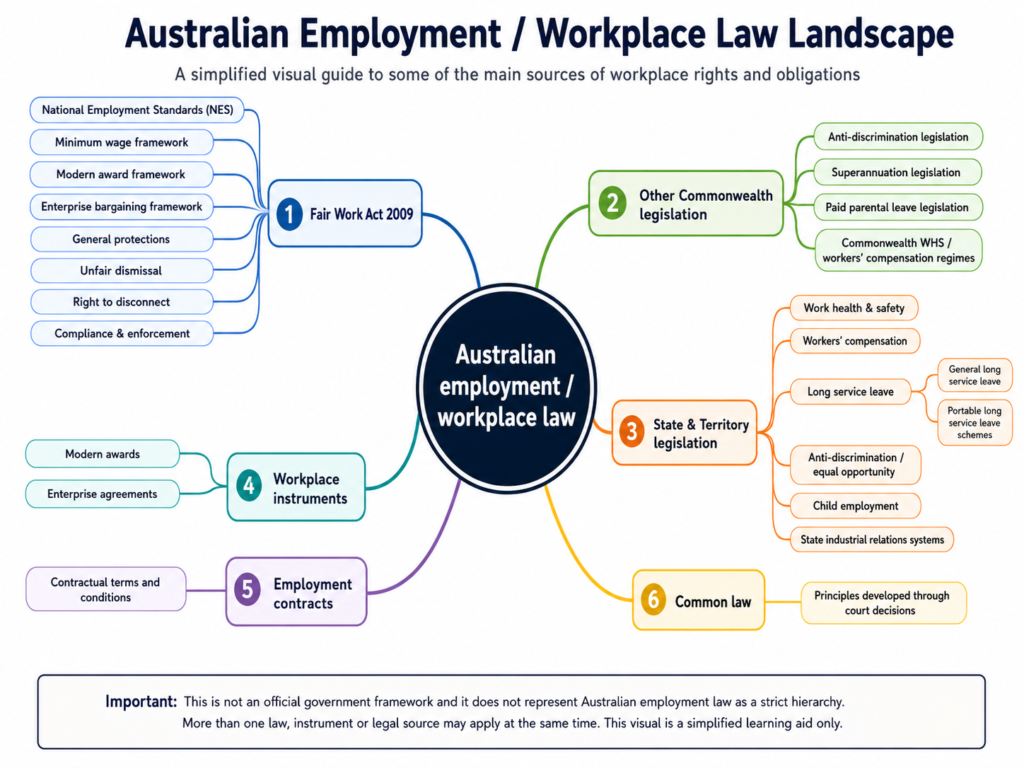
Modern awards appear twice in the diagram intentionally. They are shown under the Fair Work Act because the Act establishes the legal framework for the modern award system, and they also appear under workplace instruments because modern awards operate as legally enforceable instruments that can apply directly to covered employers and employees. The duplication is therefore intended to show both where modern awards sit within the Fair Work framework and how they function in practice.
For example, the Fair Work Act sets the rules about what modern awards may contain, including matters such as minimum wages, classifications, overtime, penalty rates and allowances. The Clerks – Private Sector Award 2020, however, is the actual workplace instrument an employer would consult to determine the specific classification, minimum rate, ordinary hours or overtime rules that apply to a clerical employee.
Consider the following examples of how several sources of employment law can be relevant at the same time:
| Workplace situation | Fair Work Act / NES | State or Territory law | Other legal source |
|---|---|---|---|
| An employee is made redundant after long service | Notice and redundancy pay may come from the NES. | Long service leave payout may come from the relevant state or territory LSL legislation. | The employment contract may provide additional termination rights. |
| An employee is injured at work | NES leave entitlements and Fair Work protections may still apply. | Workers’ compensation and WHS obligations are largely dealt with under the relevant jurisdiction’s laws. | Common-law damages may also be available, depending on the jurisdiction and statutory scheme. |
| A young employee works in retail | The NES and applicable modern award may regulate hours, pay and leave. | Child employment laws may restrict when or how long the employee can work. | The employment contract still governs agreed terms, subject to the statutory minimums. |
| An employee works across several employers in a portable LSL industry | The employee may still be covered by the NES and other Fair Work Act protections. | A portable long service leave scheme may recognise service across employers and impose separate employer obligations. | Each individual employment contract continues to govern the particular employment relationship. |
| An employee takes parental leave | The NES may provide unpaid parental leave and related entitlements (such as return to work protections and keeping in touch days). | State or territory discrimination laws may provide additional protections against discriminatory treatment. | The employee may also have contractual parental leave benefits above the statutory minimum. |
All of the examples above, but especially the “young employee” example, illustrate why it is important for small business owners, managers and HR professionals to be aware of the state and territory laws that may apply to their staff. This table is not exhaustive, and there are many other examples that demonstrate just how layered Australian employment law can be.
By way of conclusion to this vast and complex topic that is the Australian employment law landscape, the key point I have taken away is that the Fair Work Act is central, but it is not the whole picture. Workplace rights and obligations can come from a number of different sources, and more than one source may apply to the same employment relationship at the same time. Understanding where a right or obligation comes from matters because its source can determine who it applies to, what the entitlement actually is, how it interacts with other rights and what happens if it is breached. For me, having a broader understanding of the landscape makes it much easier to know where to start looking when a workplace question arises.
Finally, an encouragement to all readers: make use of the government resources available online. The Fair Work Ombudsman and Fair Work Commission websites contain a wealth of information for HR professionals, business owners, employers and employees.
If the information you find in an official government resource differs materially from anything I have written here, rely on the official source. As mentioned earlier, this article reflects my own interpretation of the information available and my professional experience; it is intended to help make the Australian employment law landscape easier to understand, not to replace the legislation or official guidance.
Further resources
Below are some other great official resources for anyone wanting to learn more about Australian employment law, workplace relations and workplace rights and obligations:
- Fair Work Ombudsman – information about minimum entitlements, pay, leave, awards, agreements, workplace rights and employer obligations.
- Fair Work Commission – information about modern awards, enterprise agreements, unfair dismissal, general protections and workplace disputes.
- Safe Work Australia – information and resources relating to work health and safety and workers’ compensation arrangements across Australia.
- Australian Human Rights Commission – information about Commonwealth discrimination laws and workplace discrimination.
- Australian Taxation Office – guidance on superannuation, tax and related employer obligations.
- State industrial relations bodies – if an employee or employer sits outside the national workplace relations system, the relevant state industrial relations body may be the appropriate place to find information about applicable employment conditions, awards or workplace disputes. These include:
- Industrial Relations Commission of New South Wales
- Queensland Industrial Relations Commission
- South Australian Employment Tribunal
- Western Australian Industrial Relations Commission
- Tasmanian Industrial Commission
- Other state and territory workplace regulators and authorities – depending on the issue, you may also need to consult the relevant state or territory body responsible for areas such as work health and safety, workers’ compensation, long service leave, portable long service leave, child employment or anti-discrimination/equal opportunity laws. The responsible authority differs depending on both the jurisdiction and the issue.
These are also useful places to start when you are unsure which part of the Australian workplace law landscape applies to a particular issue.
Website links not included:
I have intentionally not included direct links to these resources because government webpages and URLs can change over time. Instead, I have included the full name of each organisation or resource so that you can search for the most current official page yourself.
Referencing this article
If you would like to reproduce, adapt or reference any of the original commentary, tables or graphics contained in this article, please credit The People Podium Blog as the source and, where possible, include a link back to the original article.
The factual information discussed throughout this article is drawn from legislation, government resources and other publicly available sources, which are referenced where relevant. Attribution to The People Podium relates to the original commentary, structure, tables and visual material created for this article.